🚨 Your next customer will ask AI not Google...
If your website isn’t showing up, you’ll business will vanish. Fix it today for just $47.

What content formats are preferred by AI search tools like Claude and ChatGPT?
What Content Formats Are Preferred by AI Search Tools Like Claude and ChatGPT?
AI search tools are changing the rules of content visibility — and if you want to be recommended by tools like ChatGPT, Claude, or Perplexity, the format of your content matters as much as the content itself.
To rank in AI search tools like ChatGPT and Claude, prioritize clear, structured, and information-dense formats that mirror how AI answers are typically displayed:
Concise summaries
Bullet-point takeaways
Step-by-step guides
Reference-rich responses
Question-based headers
These formats help LLMs (Large Language Models) easily extract, understand, and reproduce your content in answers.
📌 Why Format Matters in the Age of AI Search
Unlike Google, where ranking is tied heavily to backlinks and on-page SEO, LLM-based AI search engines rely on content clarity, structure, and semantic coverage. That means:
If your blog looks like a great AI answer, it’s more likely to become the AI answer.
AI models scan and learn from web data to generate answers — favoring structured formats that mimic their own response style.
Content needs to be skimmable for AI and humans, long paragraphs with no structure get skipped by both.
Real Example:
Go ask ChatGPT:
“What’s the best CRM for small businesses?”
You’ll notice the result is likely a structured list, maybe even formatted like this:
HubSpot CRM – Best for growing teams
Zoho CRM – Ideal for budget-conscious businesses
Pipedrive – Sales-focused solution
🟢 If your blog mirrors this format, it’s far more likely to be included in that answer.
✅ Best Performing Content Formats for AI Visibility
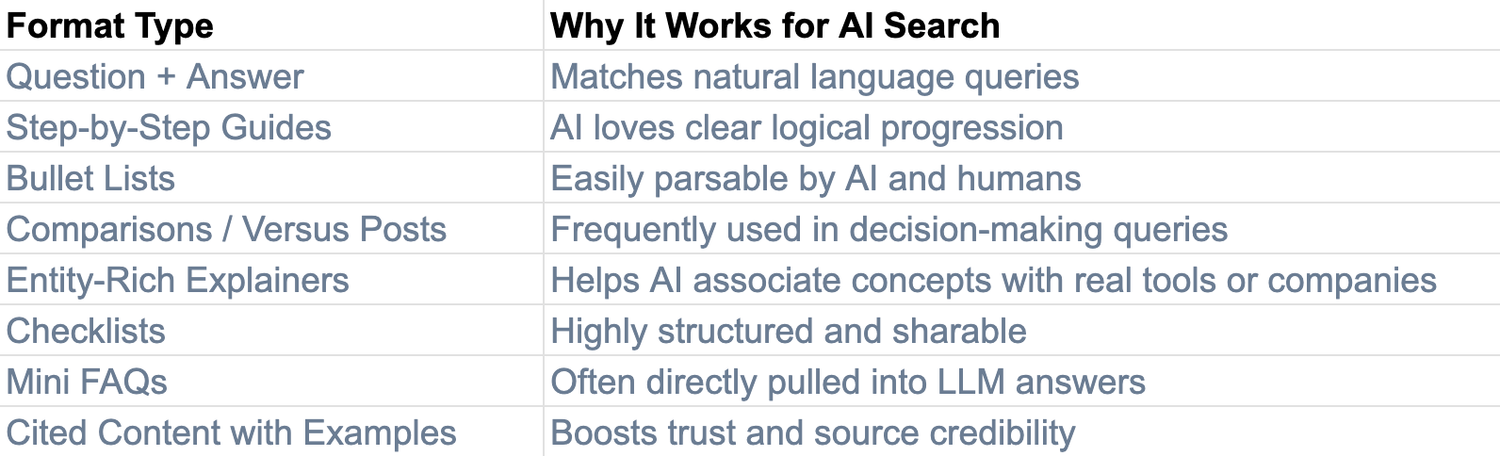
Here’s a breakdown of AI-preferred content types based on current LLM behavior and what’s typically cited in AI answers:
Want to see how we structured the content in a way AI tools love? Explore the full GEO Rank Engine Blueprint →
🧪 Tools to Format Like an AI Answer
Here are some tools that help you format and optimize your blog posts to mimic AI-preferred patterns:
Surfer SEO – for keyword-rich, semantically optimized outlines
ChatGPT / Claude – use them to simulate how your blog might be quoted in answers
NeuronWriter – optimize your layout based on NLP analysis
Hemingway Editor – simplify and structure text for maximum clarity
Glimpse (Google Trends + Reddit Search) – find how people phrase their questions
Also: Run your draft through ChatGPT and ask:
“If I asked this question in ChatGPT, would my article be quoted as the source?”
🔁 Internal Linking Strategy
Every AI-optimized blog should have internal links that reinforce topical authority.
Link to these if you’ve published them already (or plan to):
📚 Common Sources Cited by AI in Answer Format
Here are the types of sources LLMs love and commonly cite in AI search results:
Official product pages (e.g. Notion, Airtable, Jasper.ai)
Quora / Reddit threads with high engagement
Medium articles with “X steps” or “How to” formats
Backlinko, Neil Patel, Ahrefs Blog
Case studies and “real user reviews”
🔗 Example thread:
📥 Final Takeaway + Action Step
If you want your content to be picked up by AI tools, format it like the answer you want to see.
Think:
Would ChatGPT quote this part? Would Perplexity use this list?
If not, rework it.
🎯 We built the GEO Rank Engine Blueprint to teach you exactly how to structure, optimize, and automate this process with zero guesswork.
Set it up once, and your content keeps working 24/7.
→ Ready to start ranking in AI search?
Grab the GEO Rank Engine Blueprint Now
Subscribe now.
Join the GEO Radar — Get the latest AI search trends, growth hacks, and ranking strategies before they go mainstream. Straight to your inbox.
ABOUT
We’re growth hackers obsessed with cracking the future of lead generation. At GEO Rank Engine, we help businesses rank in AI search engines like ChatGPT and Perplexity, before their competitors even know what GEO is.